

In this article
- What is IBS, in simple terms?
- Common IBS symptoms
- Why IBS symptoms can feel unpredictable
- IBS and bowel movement patterns
- IBS and bloating
- The connection between food, symptoms and daily habits
- Why tracking symptoms can be useful
- When IBS-like symptoms should not simply be self-managed
- Understanding patterns, not chasing single symptoms
What is IBS, in simple terms?
Irritable bowel syndrome (IBS) is a common, long-term condition that affects how the digestive system works. Doctors often describe it as a disorder of gut–brain interaction: the gut may be more sensitive than usual, and the way the bowel moves and the way the brain and gut communicate can be altered. IBS does not damage the bowel or cause cancer, but its symptoms can be very real, uncomfortable and disruptive to daily life.
One reason IBS feels confusing is that there is no single test that shows it. A doctor usually makes the diagnosis by looking at your symptom pattern over time and, where needed, ruling out other conditions such as coeliac disease or inflammatory bowel disease. Another reason is that IBS looks different in different people. Two people with the same diagnosis can have almost opposite experiences — one mainly dealing with urgent loose stools, the other with hard, infrequent bowel movements.
Because the signals can be mixed and changeable, many people spend a long time wondering whether a symptom is ‘normal’, whether it was something they ate, or whether it means something more serious. Understanding the common patterns is a helpful first step — not to self-diagnose, but to know what to notice and what to talk about with a healthcare professional.
Common IBS symptoms
IBS symptoms tend to come and go. Not everyone experiences all of them, and their intensity can change over weeks or months.
Some people also report symptoms beyond the gut, such as tiredness, nausea, back pain or needing to urinate more often. These can happen alongside IBS but are not specific to it, so they are worth mentioning to your doctor rather than assuming they are part of IBS.
Doctors sometimes group IBS by the main bowel pattern — IBS with constipation (IBS-C), IBS with diarrhoea (IBS-D) or mixed (IBS-M). Your type can shift over time, which is one more reason symptom history matters.
| Symptom | What people often describe | Worth noting |
|---|---|---|
| Abdominal pain or discomfort | Cramping, aching or sharp discomfort, often in the lower abdomen | In IBS it is commonly related to bowel movements and may ease or change afterwards |
| Bloating | A full, tight or swollen feeling; sometimes visible distension | Often builds through the day and may feel worse in the evening |
| Diarrhoea | Loose or watery stools, sometimes with urgency | Frequency and urgency are worth recording as well as stool form |
| Constipation | Hard, lumpy stools, straining or going less often | May come with discomfort and bloating |
| Alternating patterns | Periods of constipation and periods of diarrhoea | Sometimes called IBS with mixed bowel habits |
| Changes in stool appearance | Stools that vary in shape, consistency or may contain mucus | Mucus can occur in IBS; blood is not typical and needs assessment |
| Incomplete emptying | Feeling you still need to go after a bowel movement | A common and frustrating symptom for many people |
Why IBS symptoms can feel unpredictable
Many people with IBS say the hardest part is not knowing what tomorrow will feel like. A meal that was fine on Monday may seem to cause discomfort on Thursday. A calm week may be followed by a flare-up with no obvious cause.
This happens partly because IBS symptoms can be influenced by several things at once. Food may play a role for some people, but so can stress, sleep, the menstrual cycle, physical activity, illness, medicines and changes in routine. When several of these line up, symptoms may appear stronger; when only one is present, you may not notice anything. From the inside, that can feel random.
Memory also plays tricks. It is natural to remember the worst days vividly and forget the ordinary ones. Keeping even a simple record can show that symptoms follow a rhythm — for example, being worse after poor sleep or during busy weeks — which is much harder to see from memory alone.
IBS and bowel movement patterns
Bowel habits vary widely between healthy people. Going three times a day or three times a week can both be normal. What matters more in IBS is change and pattern: how often you go, how easy or urgent it is, what your stools look like, and how you feel before and after.
A single episode of diarrhoea after a takeaway, or a couple of days of constipation while travelling, does not tell you much on its own. Looking at IBS bowel movements over two to four weeks gives a much clearer picture. Many people find the Bristol Stool Form Scale useful, as it describes seven stool types from hard lumps (type 1) to entirely liquid (type 7), giving you and your doctor a shared language.
- How many bowel movements you have each day
- Stool type, using the Bristol scale if helpful
- Urgency, straining or a feeling of incomplete emptying
- Whether pain or bloating changes after a bowel movement
- Any mucus, and — importantly — any blood or black stool
IBS and bloating
Bloating is one of the most commonly reported IBS symptoms. It may feel like pressure, tightness or fullness, and some people notice their abdomen visibly expanding through the day. For many, it is at its mildest in the morning and most noticeable by evening.
IBS bloating is not always caused by having more gas than other people. Research suggests that in some people with IBS, the gut may be more sensitive to normal amounts of gas and stretching, and the way gas moves through the bowel can be different. Constipation, the fermentation of certain carbohydrates, eating large meals quickly and swallowing air can also contribute.
Because the reasons differ, bloating experiences differ too. One person may notice it mostly after certain meals, another around their period, and another during stressful weeks. Tracking when it happens, how strong it is and what else was going on may help you see which pattern fits you.
The connection between food, symptoms and daily habits
It is very common to look at the last meal when symptoms appear. Food can be part of the picture for some people with IBS — for example, some find large or fatty meals, certain fermentable carbohydrates (FODMAPs), caffeine or alcohol may be associated with their symptoms. But no single food causes IBS, and a food that bothers one person may be completely fine for another.
Daily habits matter too. Irregular meal times, eating very quickly, low fluid intake, disrupted sleep, high stress, little physical activity and hormonal changes may all be associated with changes in digestive symptoms. The gut and brain communicate constantly, so how you feel emotionally and physically can influence how your gut feels — and the reverse is true as well.
This is why removing foods on a hunch can be frustrating. If the real pattern involves sleep or stress, cutting out a food may reduce variety in your diet without improving much. Looking at the whole day gives a fairer picture.
Why tracking symptoms can be useful
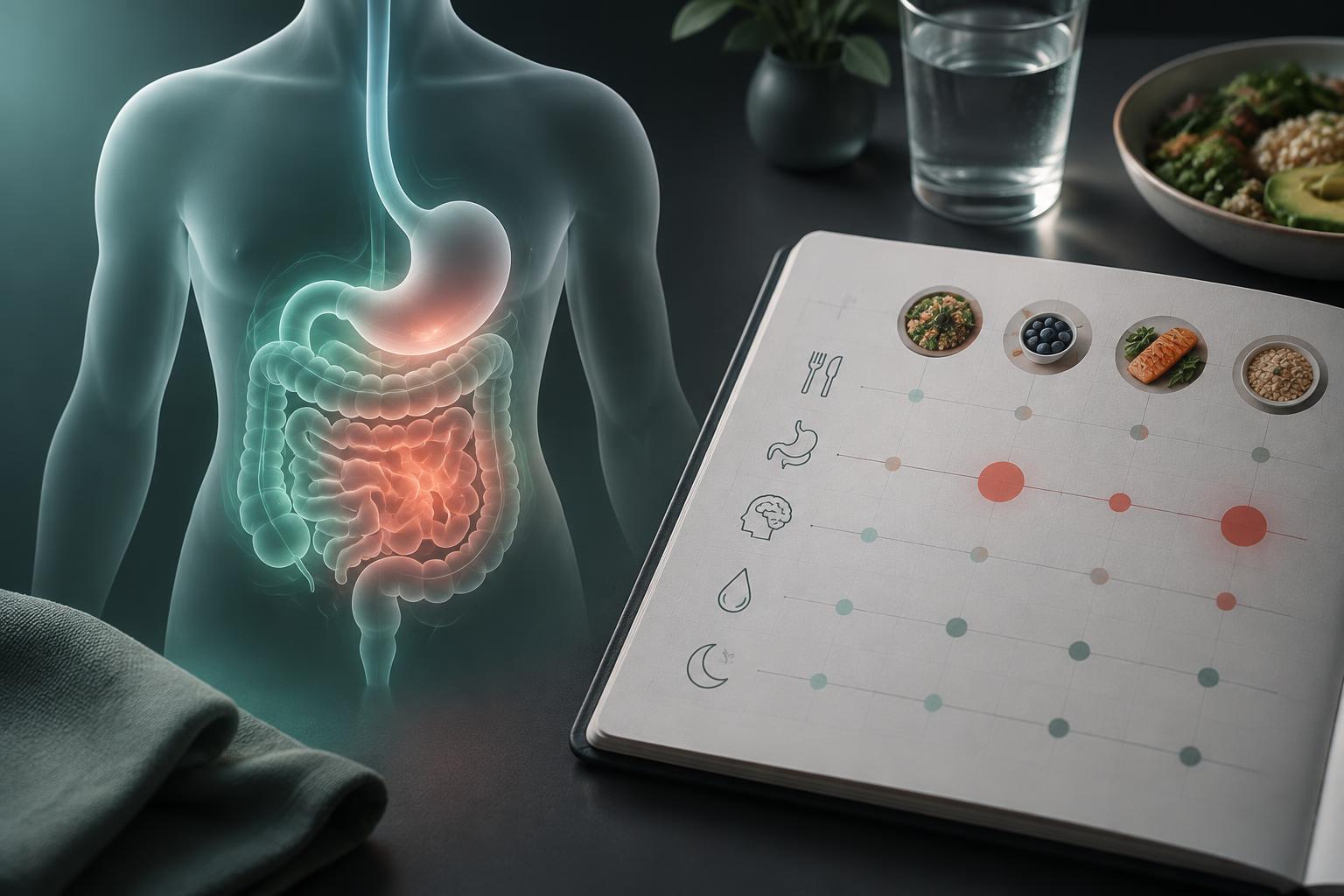
IBS symptom tracking is simply the habit of writing down what happened, so you can look back later with clearer eyes. It does not need to be perfect. Even a few consistent notes each day can reveal patterns that are easy to miss.
A symptom record can also make appointments more productive. Instead of ‘it’s been bad lately’, you can tell your doctor or dietitian how often symptoms occur, what they look like and what else was happening — information that helps them make decisions with you.
- What you ate and drank, and roughly how much
- Symptoms such as pain, bloating or urgency, with a simple 0–10 intensity
- Bowel movements and stool type
- Hydration through the day
- Sleep quality and duration
- Stress level or mood
- Other daily habits: activity, meal timing, menstrual cycle, medicines
When IBS-like symptoms should not simply be self-managed
Many digestive symptoms that resemble IBS can also be caused by other conditions, including coeliac disease, inflammatory bowel disease, infections, thyroid problems and, less commonly, bowel cancer. That is why a proper assessment matters, especially if symptoms are new, severe, persistent or different from your usual pattern.
If you have already been diagnosed with IBS, it is still important to speak to a healthcare professional if your symptoms change noticeably, stop responding to things that used to help, or start affecting your daily life significantly.
Understanding patterns, not chasing single symptoms
IBS can be unpredictable, but it is rarely as random as it first seems. Symptoms like abdominal pain, bloating and changing bowel habits are your gut’s way of signalling that something in the overall picture may be worth attention — food, sleep, stress, routine or a combination.
Rather than chasing each symptom as it happens, try stepping back and observing gently over a few weeks. With a clear record and the support of a qualified healthcare professional, many people find they understand their gut much better — and feel more in control of their day. Better gut. Better you.
At a glance
Key takeaways
- Common IBS symptoms include abdominal pain, bloating, diarrhoea, constipation or a mix of both.
- Symptoms vary between people and can change from day to day.
- Patterns over several weeks are more informative than a single episode.
- Food, sleep, stress, hydration and routine may all be associated with symptoms.
- A simple symptom record can make conversations with your doctor more useful.
- New, severe, persistent or unusual symptoms need medical assessment.
Frequently asked questions
What are the most common IBS symptoms?
The most common IBS symptoms are abdominal pain or discomfort related to bowel movements, bloating, and changes in bowel habits such as diarrhoea, constipation or alternating between both. Not everyone has every symptom.
Can IBS symptoms change over time?
Yes. IBS symptoms often come and go, and the main bowel pattern can shift over months or years. Tracking helps you and your doctor notice these changes.
Is bloating always a sign of IBS?
No. Bloating is common in IBS but also happens for many other reasons, including constipation, large meals and hormonal changes. Persistent or worsening bloating should be discussed with a doctor.
Can stress make IBS symptoms worse?
Many people with IBS notice symptoms change during stressful periods. The gut and brain communicate closely, so stress may be associated with changes in pain, bloating or bowel habits.
How long should I track my symptoms?
Two to four weeks of consistent notes is often enough to start seeing patterns, though longer records can show cycles such as monthly hormonal changes.
Can an app diagnose IBS?
No. Only a qualified healthcare professional can diagnose IBS. Apps like Gut Pace help you organise your symptom and lifestyle information so you can review patterns and share them with your doctor.
When should I see a doctor about IBS symptoms?
See a doctor if you have not been diagnosed, if symptoms are severe or changing, or if you notice warning signs such as blood in your stool, unexplained weight loss, fever or symptoms that wake you at night.
Editorial information
Reviewed by the Gut Pace Editorial Team for evidence-informed wording, practical clarity and appropriate medical-safety guidance. Gut Pace is a tracking tool; it does not diagnose, treat, cure or prevent IBS or any other condition.
Last reviewed: Sep 25, 2026
Sources & further reading
- NIDDK — Irritable bowel syndrome (IBS)
- NIDDK — Symptoms and causes of IBS
- NHS — Irritable bowel syndrome (IBS)
This article is for general information only and is not medical advice. It does not diagnose or treat any condition. Speak with a doctor or registered dietitian about persistent, severe or concerning symptoms.