

In this article
- The FODMAP groups in plain English
- Why portion size and FODMAP stacking matter
- The three phases of a low-FODMAP approach
- How to track a FODMAP reintroduction
- High FODMAP foods and practical alternatives
- Who should get professional guidance before starting?
- Common mistakes in a low-FODMAP trial
- How FODMAPs can produce symptoms in a sensitive gut
- Worked example: testing one FODMAP group
- Protect nutrition and food confidence during the process
The FODMAP groups in plain English
The categories describe carbohydrates, not whether a food is good or bad. Many high-FODMAP foods are nutritious and may be tolerated in smaller servings.
| Group | Common examples | What the name means |
|---|---|---|
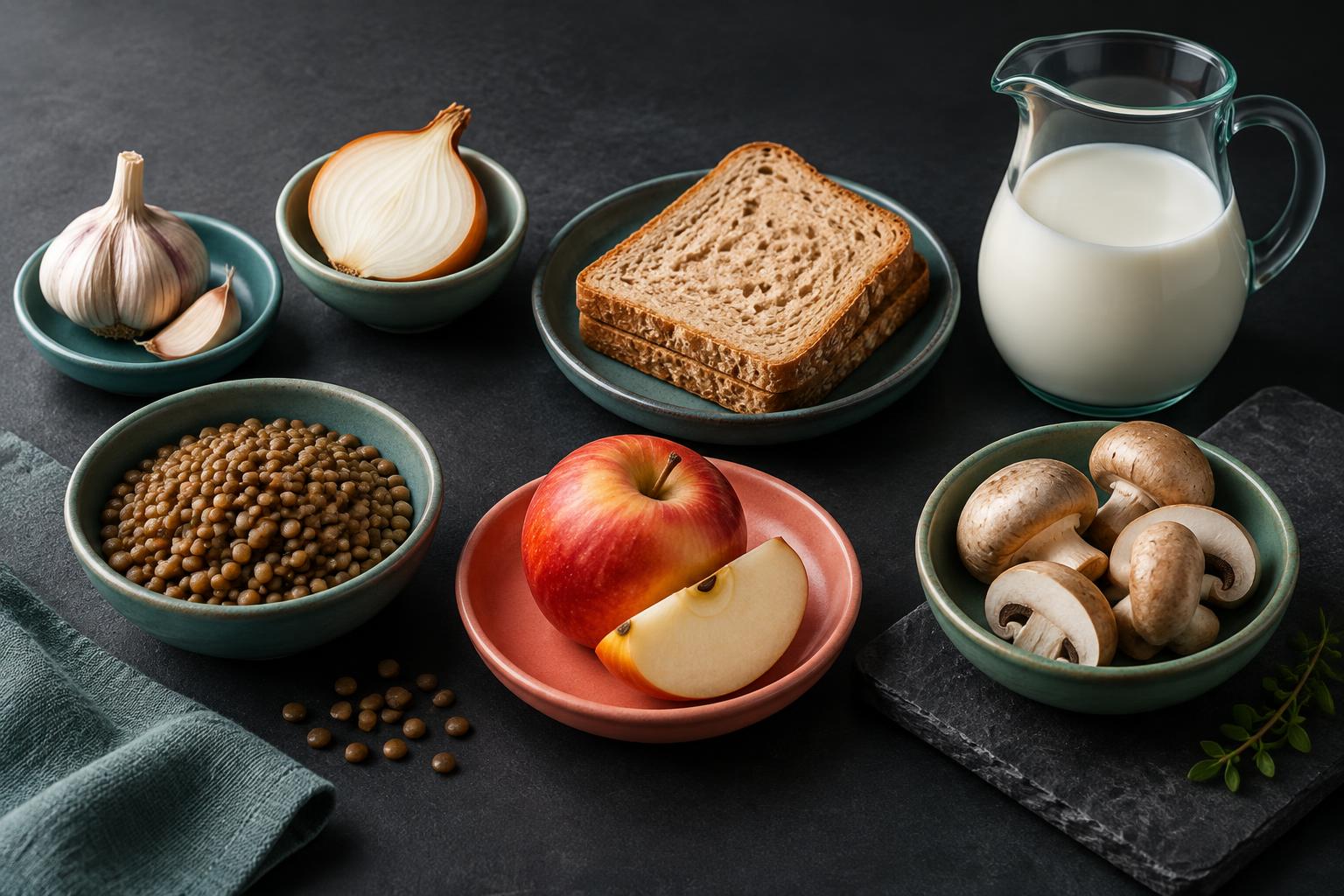
| Oligosaccharides | Wheat, rye, onion, garlic, legumes | Fructans and GOS |
| Disaccharides | Milk, soft cheese, some yoghurt | Lactose |
| Monosaccharides | Honey, mango, excess-fructose foods | Fructose in excess of glucose |
| Polyols | Stone fruit, mushrooms, some sweeteners | Sorbitol, mannitol and related sugar alcohols |
Why portion size and FODMAP stacking matter
FODMAP ratings are tied to a tested serving. A smaller amount may be low while a larger serving is high. Eating several moderate sources close together can also increase the total fermentable load.
- Record approximate portions rather than only food names.
- Consider the complete meal, including sauces and snacks.
- Retest one FODMAP group at a time during reintroduction.
- Use symptoms as data, not proof of a diagnosis.
The three phases of a low-FODMAP approach
- 1
Short restriction
Temporarily reduce high-FODMAP foods with professional guidance while keeping meals nutritionally adequate.
- 2
Structured reintroduction
Challenge one group and dose at a time to learn what you tolerate.
- 3
Personalisation
Bring back tolerated foods and portions so the long-term diet is as varied as possible.
How to track a FODMAP reintroduction
Keep the test food, dose, time, symptoms and relevant context in one place. Sleep, stress, menstrual cycle and an unusually large meal can change how a challenge feels.
During reintroduction it is easy to lose track of which group you tested, at what portion and on which day. Gut Pace grades the FODMAP content of logged ingredients and keeps symptoms on the same timeline, which makes each test easier to review with your dietitian. It does not decide which foods you should avoid.
High FODMAP foods and practical alternatives
Swaps are temporary tools for the restriction phase, not judgments about which foods are healthier. Serving sizes still matter, and a dietitian can help preserve enough energy, fibre and nutrients.
| Higher-FODMAP example | Alternative to consider | Important detail |
|---|---|---|
| Onion or garlic pieces | Garlic-infused oil or chives | Fructans are not oil-soluble; remove garlic solids |
| Regular milk | Lactose-free milk | Lactose tolerance varies by dose |
| Apple or pear | Orange, grapes or kiwifruit | Use tested serving guidance |
| Large wheat bread serving | Suitable gluten-free bread or tested sourdough | Low FODMAP is not the same as gluten-free |
| Large pulse portion | Smaller drained canned pulse portion | Some carbohydrates move into the canning liquid |
Who should get professional guidance before starting?
A low-FODMAP diet is not the right first step for every digestive symptom. A clinician should assess unexplained or persistent symptoms and consider conditions such as coeliac disease before major dietary changes.
Dietitian support is especially valuable for children, pregnancy, eating-disorder history, low body weight, multiple allergies, other medical diets or an already limited food range.
Common mistakes in a low-FODMAP trial
- Treating high FODMAP as another word for unhealthy.
- Ignoring the serving size attached to a food rating.
- Combining several moderate servings and overlooking stacking.
- Removing gluten when fructans, not gluten, are the target being tested.
- Staying in restriction instead of progressing to reintroduction.
- Changing supplements, meal timing and many foods at the same time.
How FODMAPs can produce symptoms in a sensitive gut
FODMAP carbohydrates are poorly absorbed or slowly absorbed in the small intestine. Some can draw water into the bowel, and when they reach the large intestine, microbes ferment them and produce gas. These are normal processes; symptoms depend on dose and individual sensitivity.
People with IBS may experience distension as pain, pressure, urgency or altered bowel movements because the gut is more sensitive or moves differently. The same fermentation can occur with few symptoms in someone else.
This mechanism explains why a food can be nutritious and still trigger symptoms in a particular portion. It also explains why reducing FODMAPs can support symptom testing but does not cure IBS or identify an allergy.
Worked example: testing one FODMAP group
After a successful short restriction phase, a dietitian may help choose one challenge food that mainly represents a single FODMAP group. The person tries a planned portion while the rest of the diet remains stable, then records symptoms over the agreed period.
If the first portion is tolerated, the next challenge may increase the amount. If symptoms are significant, the challenge stops and a recovery period follows. A response informs that food, amount and context; it does not automatically apply to every food in the group.
Challenge order, food and portions should follow validated guidance. Online food lists can become outdated as laboratory testing changes, so use a current specialist resource.
| Challenge day | What stays consistent | What changes | What to record |
|---|---|---|---|
| Baseline | Usual lower-FODMAP meals | Nothing | Typical symptoms and stool pattern |
| First challenge | All other meals | Planned small serving | Timing, severity and bowel changes |
| Later challenge | Same background diet | Larger planned serving if appropriate | Whether response is dose-related |
| Recovery | Return to baseline pattern | Challenge food pauses | Time taken for symptoms to settle |
| Personalisation | Nutritionally adequate varied diet | Tolerated foods return | Comfortable amounts and combinations |
Protect nutrition and food confidence during the process
Restriction can reduce fibre, calcium or overall energy if common foods are removed without suitable replacements. It can also make eating socially harder. Planning what to include is therefore as important as knowing what to limit.
Keep meals balanced with tolerated carbohydrates, protein, fats and produce. Choose replacements that serve a similar nutritional role—for example, lactose-free dairy rather than simply removing dairy if it suits your needs.
If food rules are causing fear, weight loss, binge–restrict cycles or difficulty eating with others, pause and seek help. A low-FODMAP process should increase useful knowledge and dietary freedom, not create a permanently smaller life.
- Plan replacements before removing staple foods.
- Monitor bowel regularity when fibre sources change.
- Reintroduce systematically rather than waiting for a perfect symptom-free period.
- Include cultural and budget needs in the plan.
- Ask a specialist dietitian for help when nutrition or food confidence is at risk.
At a glance
Key takeaways
- FODMAPs are fermentable carbohydrates, not a list of unhealthy foods.
- Serving size determines whether many foods are low or high FODMAP.
- Restriction should be short and followed by reintroduction.
- The goal is a varied, personalised diet—not permanent avoidance.
- A dietitian can make the process safer and clearer.
Frequently asked questions
What does FODMAP stand for?
Fermentable oligosaccharides, disaccharides, monosaccharides and polyols.
Is a low-FODMAP diet permanent?
No. It is normally a short restriction followed by systematic reintroduction and personalisation, ideally with a dietitian.
Are all high-FODMAP foods unhealthy?
No. Many are nutritious foods. The label relates to fermentable carbohydrate content at a serving size, not overall quality.
Can FODMAPs cause IBS?
FODMAPs do not cause IBS, but they can trigger symptoms in some people who already have a sensitive gut.
Why can I tolerate a small portion but not a large one?
The amount of fermentable carbohydrate increases with serving size, so tolerance often has a dose threshold.
Is a low-FODMAP diet the same as a gluten-free diet?
No. Wheat can be limited because it contains fructans, while gluten is a protein. People with coeliac disease need a strict gluten-free diet for a different medical reason.
How long does the restriction phase last?
It is intended to be short and followed by structured reintroduction. Exact timing should be personalised with a dietitian rather than extended indefinitely.
Can children or pregnant people follow a low-FODMAP diet?
Because nutritional needs are especially important, this should only be considered with medical and dietetic supervision.
Editorial information
Reviewed by the Gut Pace Editorial Team using established Monash and peer-reviewed FODMAP guidance. Gut Pace does not replace dietetic supervision.
Last reviewed: Sep 12, 2026
Sources & further reading
- Monash University — About FODMAPs and IBS
- PubMed — How to institute the low-FODMAP diet
- PubMed — Low-FODMAP diet trial in IBS
- NIDDK — Eating, diet and nutrition for IBS
- British Dietetic Association — IBS and diet
- NIDDK — Coeliac disease
This article is for general information only and is not medical advice. It does not diagnose or treat any condition. Speak with a doctor or registered dietitian about persistent, severe or concerning symptoms.